
Ash dieback: Epidemiology, spread and mapping — ash in urban valleys

Definition
Ash dieback is a fungal disease of ash trees caused by the organism Hymenoscyphus fraxineus. It infects leaves in summer, grows into twigs and branches, and over time causes crown thinning, deadwood and, in many cases, failure. In the United Kingdom it is widespread and requires active management by tree owners. Forest Research
Valleys can be beautiful places to grow ash. They can also be perfect for ash dieback. Moist air lingers. Leaf litter sits. Spores have time to stick.
In this guide we explain how ash dieback behaves in sheltered urban valleys, what to look for on your trees, and the simple mapping steps that help you prioritise work and protect people.
Epidemiology in brief (and why summer mornings matter)
The fungus overwinters on last year’s ash leaf stalks in the litter. In late spring to early autumn, tiny white cups (apothecia) form on those stalks and release wind-borne spores that infect living leaves. Infection pressure rises in warm, humid weather. Studies show spores are commonly available from late May through September, often peaking in the morning, and their release is strongly influenced by recent sunshine, rainfall and humidity. That timing matters for walks, inspections and leafy garden clean-ups. bsppjournals.onlinelibrary.wiley.com+1
Most spores settle near the source, especially within tens of metres, but effective mean spread in landscapes is typically measured in hundreds of metres to a few kilometres, with human movement of plants and materials historically extending that range. In plain terms: if your garden ash sits below a line of infected trees, expect a steady rain of spores each summer. bspp.org.uk+1
Practical line: If you manage sites used in the morning—school runs, play areas, rights of way—plan inspections in July–September.
Ash in urban valleys: microclimate and spread dynamics
In the North West, valley bottoms and wooded cuttings often hold cooler, wetter air on summer nights. Dew lasts longer. Leaves stay wet. The longer leaves stay wet, the more chance spores have to germinate and invade. Sheltered corridors along streams, railway lines and roadside belts can therefore act as “spore sinks,” especially where ash leaf litter is left undisturbed year on year. When you add dense stands of ash, infection and severity tend to rise. PMC+2PMC+2
In contrast, isolated street trees on exposed clay ridges or coastal fringes around Greater Manchester and the Mersey corridor may experience shorter leaf-wetness periods and, in some cases, milder symptoms—though exposure brings its own structural risks. Site matters.
Grounded vignette (anonymised):
On a mid-July morning walk along a public right of way in a Salford valley, we found three mature ash lining an access track to garages. The upstream belt was dense, with last year’s leaf stalks matted under nettles. By 10am, leaves still felt wet to the touch. Two trees showed dark petiole lesions and early shoot dieback in the outer crown; the isolated ash further upslope showed only light thinning.
Ash dieback lookalike (once): old frost or drought damage can mimic peripheral dieback on south-facing slopes. Check for new “diamond” lesions at former leaf joints to confirm. Woodland Trust+1
Practical line: If your ash sits low beside water or a shaded track, expect faster progression—book a survey sooner.
Symptoms / What does ash dieback look like? (merged)
Crown:
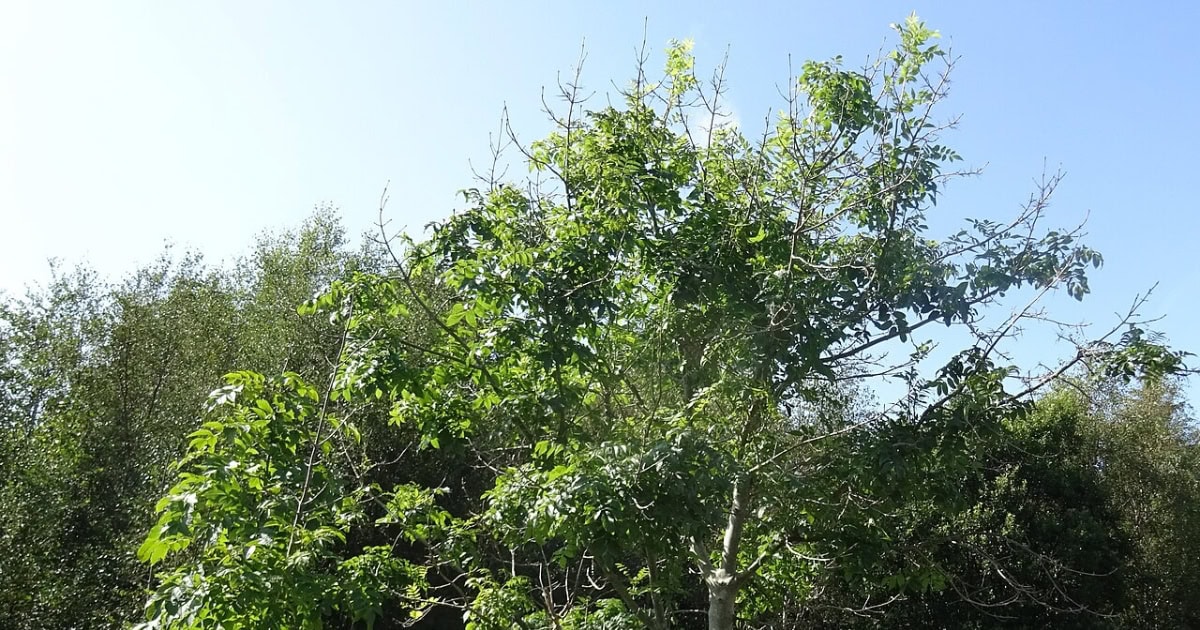
- Mid-summer thinning of the outer canopy.
- Tufts of new shoots sprouting lower down the stem (stress-driven epicormic growth). Woodland Trust
Leaves and shoots:
- Dark blotches along the leaf midrib and base in summer; leaves may shrivel and blacken while still attached.
- New season shoots darken and die back from the tip. rhs.org.uk+1
Bark and branches:
- Sunken, diamond-shaped lesions where side branches meet the stem or at former leaf joints. Lift a small flap of dead bark (carefully): the inner bark is grey-brown rather than healthy pale green. Woodland Trust
Two checkable details for owners:
- Stand in the same spot and compare photos from the last two July–Augusts; progressive outer-crown thinning is a red flag.
- Look for diamond lesions at last year’s nodes on small branches; they are reliable markers when leaves are off.
Ash dieback lookalike (once): honey fungus, Inonotus hispidus or Perenniporia fraxinea can appear alongside dieback and alter risk; bring in a professional if you see bracket fungi. The Tree Council
Practical line: If you see progressive thinning and diamond lesions over a path or play area, book a survey.
Disease stages and practical risk cues
Early stage: leaf blotches and first-year shoot dieback.
Mid stage: expanding lesions, dead twigs, developing deadwood.
Advanced: significant crown loss, longitudinal stem lesions, brittle deadwood; secondary decay fungi may be present.
Risk rises with over-target exposure (roads, garden seating, school boundaries) and with decay organisms. Government guidance advises proportionate, risk-based management rather than blanket felling. GOV.UK
Practical line: If deadwood is forming over parking or play, do not delay—arrange an inspection and risk assessment.
Mapping and monitoring on your land
You do not need specialist software to start.
- Give each ash a number on a simple plan or Ordnance Survey base.
- Record crown thin class (for example: <25%, 25–50%, >50%).
- Add photos in July or early August each year from the same spot.
- Note targets (paths, roads, garden areas), and access constraints (narrow tracks, overhead services).
- For larger sites, keep a simple GPS/smartphone point with a note.
- Where it helps decision-making, a professional survey can use drone or remote-sensing methods to quantify crown condition. Forest Research+1
Observatree and Forest Research keep national resources, including mapping and reporting tools for new sightings (TreeAlert). Use these to check wider patterns or report novel finds. Woodland Trust+1
Practical line: Mark trees now and re-photo next July—trend beats guesswork.
Keep or fell? Pros and cons (owner-focused)
Pros of retaining a mildly affected ash
- Shade and landscape value remain.
- Potential genetic tolerance—keeping safer, mildly affected trees supports long-term ash recovery.
- Lower short-term costs (monitoring and pruning rather than dismantling). Queen Mary University of London+1
Cons of retaining
- Ongoing inspection costs.
- Progressive deadwood and uncertainty in valley microclimates.
- Eventual need for reduction or removal if condition declines.
Pros of removal
- Risk over high-use targets is eliminated.
- No ongoing inspection costs for that tree.
Cons of removal
- Immediate cost; access issues on tight Manchester lanes and clay gardens.
- Loss of canopy habitat; potential “over-fell” if done prematurely.
- Permission may be required for Tree Preservation Orders or Conservation Areas.
Government and sector guidance emphasise risk-based decisions, not automatic felling. Check protections (Tree Preservation Order, Conservation Area) with your local authority before work. GOV.UK
Practical line: If risk is low and the tree is stable, favour retention with monitoring; if risk is high, act.
What owners can do now (Steps)
- Walk the site in July–September after breakfast; look for crown thinning, blackened leaves and diamond lesions. rhs.org.uk
- Rake and remove ash leaf litter under garden trees in late autumn to reduce the local spore source; compost securely on-site where possible. bartlett.com+1
- Photograph the crown from the same spot each summer and keep a simple log.
- Reduce immediate hazards (deadwood over paths, play, parking).
- Check protections (Tree Preservation Orders/Conservation Areas) before any works; get consent when required. GOV.UK
- Book a professional survey if the tree overhangs a right of way, busy road or garden seating, or if bracket fungi appear.
Practical line: If you manage a public right of way, set a recurring summer photo point now.
Mini-case: recent work in Greater Manchester (3–4 lines)
Location: valley garden in Stockport, clay soils above a culverted brook.
Situation: two mature ash over a shared access track; outer crowns thinning ~30–40%, diamond lesions confirmed; morning leaf wetness persisted past 10:30 in July.
Decision: retained both with selective deadwood removal and a 15% crown reduction over the track; instituted annual July photo-monitoring and autumn leaf-litter management.
Outcome: stable risk profile for now; plan to reassess after next summer’s photo set.
FAQs (owner-focused)
Can ash dieback spread to my other trees?
The fungus is host-specific to ash. It does not infect oak, beech or sycamore, though secondary decay organisms can colonise weakened ash. Forest Research
When in the year does infection happen?
Late spring through early autumn, with many spores in summer mornings; weather drives the daily peaks. bsppjournals.onlinelibrary.wiley.com+1
What does early infection look like?
Dark blotches on the leaf midrib, shrivelling leaves, and tip dieback of new shoots; later, sunken diamond lesions at branch junctions. rhs.org.uk+1
Is there any treatment?
There is no licensed fungicide cure. Good hygiene and targeted pruning for safety are the norm; focus on risk-based management and long-term monitoring. bartlett.com+1
Are any trees resisting the disease?
Yes. Young stands in Britain are showing signs of developing genetic resistance; retaining safe, mildly affected trees may support that recovery. Queen Mary University of London+1
TL;DR
Urban valleys in the North West hold moisture and leaf litter, extending leaf-wetness and spore contact. That speeds ash dieback in dense, sheltered belts along streams, tracks and roads. Identify diamond lesions and crown thinning in summer, clear leaf litter in gardens, map your trees with photos, and manage risk over paths and parking. Keep safe, mildly affected trees under review—some are proving more tolerant. bsppjournals.onlinelibrary.wiley.com+2Forest Research+2
Clear local CTA
Need a calm, practical plan for your ash? We survey trees across Greater Manchester, Merseyside, Cheshire and Lancashire—gardens, roadside belts and public rights of way. Book an ash dieback risk survey and we’ll map, photograph and prioritise works that keep people safe and retain what can be retained.
References (selection)
Forest Research (United Kingdom): Ash dieback overview. Forest Research
GOV.UK: Managing ash dieback in England. GOV.UK
Mansfield et al., 2018: Infection assays and seasonal spore window. bsppjournals.onlinelibrary.wiley.com
Burns et al., 2022: Meteorology and spore timing. PMC
Woodland Trust: Owner symptom guide and tolerance note. Woodland Trust
Kew & Queen Mary, 2025: Evidence of evolving resistance. Queen Mary University of London
Bartlett Tree Experts (UK): Practical hygiene/vitality notes. bartlett.com
Book in your tree survey today
Get clear, professional advice from qualified tree surveyors you can trust. Whether you need a report for planning, insurance, mortgages or safety, we’ll deliver accurate results fast.