
Ash dieback identification and diagnosis: safe surveying of brittle ash in the North West
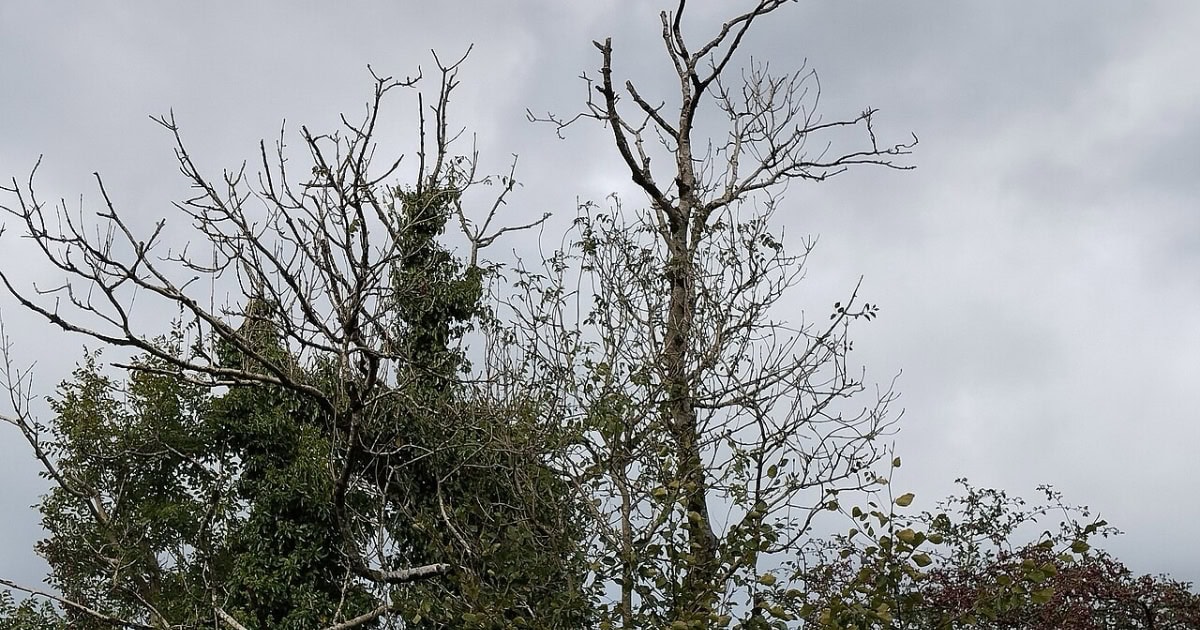

Ash dieback is now part of life for tree owners across the North West. The goal is not blanket felling. It is accurate identification, safe surveying of increasingly brittle ash, and proportionate decisions that keep people safe while retaining trees that can be kept. That is what this guide delivers, in plain English.
What is ash dieback?
Ash dieback is a fungal disease caused by Hymenoscyphus fraxineus. It infects ash leaves in summer, moves into shoots and branches, and can lead to progressive crown loss, lesions, and an increased risk of brittle failure. The most reliable time to spot leaf and shoot symptoms is mid to late summer; early autumn colour can hide the signs (Forest Research, 2025).
If you only remember one thing: make your identification in summer, then confirm by looking for diamond-shaped lesions where last year’s shoots meet the parent stem.
Symptoms and what it looks like (with one ash dieback lookalike to avoid)
Crown and leaf signs you can see from the ground
Stand back and compare your ash with others nearby during July to September. Look for blackening or wilting of leaves and shoots while other ash are still in healthy leaf. You may notice limp “flags” of dead tips in otherwise green foliage. In the North West, wet summers make these contrasts obvious in August. These are classic signs described by Forest Research and by the Royal Horticultural Society.
Bark and branch clues that clinch the diagnosis
Diamond-shaped lesions centred at nodes—where a small side shoot or twig meets the stem—are highly characteristic. If a professional carefully lifts a flake of bark at a lesion, the sapwood beneath often shows brown-grey staining that extends beyond the discoloured bark. Observatree’s field guides illustrate these details well.
The single ash dieback lookalike worth noting
Drought stress and general decline can also produce leaf flagging and early leaf fall. The way to avoid a false call is simple: check for those diamond lesions at last year’s nodes in mid to late summer. If you cannot find them, hold off and re-check when seasonal conditions are right.
Practical cue: If you can see these symptoms over a play area, driveway, or patio, book a survey.
Ash dieback disease stages you can use
Laboratory scales are helpful, but owners need a practical framework that guides action. Here is the approach we use on domestic sites:
- Early stage – Scattered leaf blackening on a few shoots; perhaps one or two diamond lesions; crown otherwise full.
Action: Take photographs; re-inspect at the height of next summer; compare year on year (Forest Research). - Mid stage – Visible thinning in the upper crown; multiple lesions; some small deadwood begins to appear.
Action: Assess the targets beneath (people, vehicles, structures). Increase re-inspection frequency. Consider stand-off pruning or changes that reduce target occupancy. The National Tree Safety Group’s guidance supports this proportionate approach. - Late stage – Significant crown loss; lesions may be joining up; brittle deadwood present; occasional basal lesions, sometimes with secondary decay such as honey fungus.
Action: Avoid climbing. Plan close inspection or works using a mobile elevating work platform. Create temporary exclusion zones if targets are frequently present. - Terminal stage – Extensive dieback with unpredictable branch or stem failure risk.
Action: Plan removal or heavy reduction from a mobile elevating work platform, with traffic or pedestrian management where needed. The Health and Safety Executive sets out the hierarchy for working at height and the use of mobile elevating work platforms.
Practical cue: If a late-stage ash overhangs a road or a public right of way, do not delay—book a professional assessment.
Surveying brittle ash safely: techniques that work (and their limits)
Brittle ash changes the playbook. Our priority is to reduce exposure and avoid placing a person in a weakening canopy unless there is no safer route, in line with the Work at Height Regulations 2005.
How we approach it, step by step:
- Ground-based optics first. We use binoculars and, where needed, pole-mounted cameras to inspect unions, lesions, and deadwood. This is quick and low-risk, but it cannot reveal hidden defects.
- Stand-off target checks. We look at desire lines, play equipment, driveways, parking bays, garden seating, public rights of way, and road verges. Risk is about both the tree and the people or property beneath it. The National Tree Safety Group emphasises this proportional view.
- Mobile elevating work platform access. When we must inspect closely or carry out works, a mobile elevating work platform is usually safer than rope access on diseased ash. It provides a stable platform but needs level ground, adequate bearing capacity, and traffic management on narrow streets. The Health and Safety Executive provides clear guidance on planning and using mobile elevating work platforms.
- Drone imaging where appropriate. Drones can map crown dieback, identify dead leaders, and view awkward lines of trees. They are excellent for overviews but limited under dense canopies and governed by airspace and privacy rules.
- Exclusion zones. Temporary fencing or signage during windy periods or while works are scheduled can sharply reduce risk at low cost. This is often the most proportionate first step for lightly used areas.
- Short re-inspection cycles. Ash can change fast over a single wet summer. Re-inspect in six to twelve months, or sooner where targets are high. Forestry Commission guidance supports frequent checks where risk may increase rapidly.
Pros and cons in plain terms:
- Binoculars and pole cameras: minimal risk and modest cost, but limited where defects are internal or shaded.
- Mobile elevating work platform: safer than climbing in brittle trees; needs planning, access, and ground bearing checks.
- Drone: wide, efficient coverage; less detail at unions and within dense foliage; airspace constraints apply.
- Rope access: last resort on diseased ash. Fibres can be brittle and failures unpredictable. Only consider with a strong justification and full rescue planning.
Practical cue: If a contractor proposes rope access in a late-stage ash over your garden, ask why a mobile elevating work platform is not being used.
Using the Tree Risk Assessment Qualification to make decisions you can stand behind
The Tree Risk Assessment Qualification from the International Society of Arboriculture is a recognised framework that combines likelihood of failure with consequence of impact. We record the targets beneath the tree—your driveway, your neighbour’s play area, a public right of way, or a busy road—then we assess defect indicators such as lesions, deadwood, and weak unions. We assign a likelihood band and cross it with consequence to arrive at a risk rating. That rating informs clear options: remove, reduce, manage targets, or monitor.
In the North West, context matters:
- A mid-stage ash over a frequently used driveway on shrinkable clay can pose a higher consequence than the same tree over a quiet field margin near Knutsford.
- A small group next to a fast commuter route or a popular public right of way near Bolton carries a high target value even if the trees are only mid stage.
- In coastal locations such as parts of the Wirral, exposure raises loads and can turn minor defects into failures during storms.
Limits worth accepting: brittle trees hide defects, and progression can be swift after wet summers. What is a “possible” failure today can become “probable” next season. Short re-inspection cycles and photographic records are the practical answer.
Practical cue: If a Tree Risk Assessment Qualification report records “probable failure” over a play area, act now rather than waiting for autumn.
Legal and local: permissions, felling licences, five-day notices, and wildlife
In England, felling often requires a Forestry Commission licence unless an exemption applies. Tree Preservation Orders and Conservation Area protections still apply to ash with dieback. Where a protected tree is dead or poses an immediate danger, councils commonly accept a five-day notice. Works should be limited to removing the immediate risk, and you should keep evidence: photographs, survey notes, and measurements. Your local planning authority can advise on the process, and Forestry Commission guidance explains when felling licences are required.
Plan for wildlife. Bats and nesting birds are protected by law. Timing and survey requirements may affect how and when work proceeds. A competent arboricultural consultant will advise and record decisions so that you have a clear paper trail.
Practical cue: If you believe a protected ash presents an immediate danger, notify the local planning authority in writing with photographs before works wherever possible.
North West realities—and two checks you can do today
Our region’s conditions shape outcomes. Wet summers favour infection and sporulation. Coastal exposure around the Mersey estuary and Morecambe Bay, and Pennine winds toward the east of Greater Manchester, increase loads on already compromised branches. Shrinkable clay soils across many Manchester districts alter rooting depth and stability as ground conditions swing from drought to saturation.
Two simple, checkable steps for owners:
- Compare photographs from the last two summers. Use the same angle if you can. If the crown has thinned markedly, book a survey in peak summer.
- Check for diamond lesions at last year’s nodes. One or two lesions might point to early stage. Many lesions that are joining up are a late-stage cue.
Practical cue: If both checks are positive and people or property are regularly beneath the canopy, it is time to book a survey.
A grounded vignette from our recent work
Last August in Sale we were asked to check an ash over a trampoline. From the driveway you could see flags of dead tips against green foliage. Three diamond lesions at successive nodes on a scaffold limb confirmed our suspicion, and brittle twig snap under light finger pressure underlined the risk. We set an exclusion zone that afternoon and scheduled a mobile elevating work platform inspection the same week. The family kept the play area closed until remedial works were complete.
A mini-case from a roadside belt
Location: B-road verge near Ramsbottom, at the edge of a public right of way.
Situation: Two mid-stage ash with summer footfall beneath. Both had lesions; one also had basal bark necrosis.
Decision: Stand-off reduction for the better-conditioned tree, and sectional removal of the other from a mobile elevating work platform with traffic management. We also widened the footpath line slightly to reduce target exposure. This is proportionate risk management in practice: reduce risk without unnecessary loss.
In short
- Identify in summer. Confirm with diamond lesions at last year’s nodes.
- Survey from the ground first. Use mobile elevating work platforms rather than rope access on late-stage trees.
- Use the Tree Risk Assessment Qualification to weigh likelihood and consequence in the real places people use—driveways, gardens, public paths, and roads.
- Keep records, re-inspect soon, and use five-day notices only for genuine danger.
- Where risk is low and structure is sound, retain ash that appear tolerant. Research from the Royal Botanic Gardens, Kew, and Forest Research suggests some trees show meaningful tolerance.
Ready to act?
If you are in Greater Manchester, Cheshire, Merseyside, or Lancashire, we can carry out a Tree Risk Assessment Qualification informed ash dieback survey, plan safe access with mobile elevating work platforms where required, and handle the permissions and evidence trail you will need for your local planning authority. Send us a message with your location and a couple of photographs, and we will advise the next step.
References and further reading
- Forest Research. “Ash dieback (Hymenoscyphus fraxineus) – identification and guidance.” 2025.
- Forestry Commission. “Managing ash dieback in England.” United Kingdom Government guidance, 2025.
- Arboricultural Association. “Ash Dieback Guidance for Tree Owners, Managers and Contractors.”
- National Tree Safety Group. “Common Sense Risk Management of Trees,” full guidance, 2024.
- Health and Safety Executive. “Using mobile elevating work platforms safely” and “Work at Height Regulations 2005.”
- International Society of Arboriculture. “Tree Risk Assessment Qualification – methodology overview,” 2025.
- Observatree. “Field guide to ash dieback symptoms and lookalikes.”
- Royal Botanic Gardens, Kew. “Current research on tolerance in European ash,” 2025.
Short legal note: This article provides general guidance for England and the North West of the United Kingdom. Tree Preservation Orders, Conservation Areas, felling licences, and wildlife legislation impose legal duties. Use five-day notices only for immediate danger, keep clear evidence, and consult your local planning authority and the Forestry Commission before works.
Book in your tree survey today
Get clear, professional advice from qualified tree surveyors you can trust. Whether you need a report for planning, insurance, mortgages or safety, we’ll deliver accurate results fast.