
Managing Ash in Woodlands (Silviculture): Timber markets and timing — when removal stacks up

Quick outline
- What ash dieback is and why timing matters
- How to recognise symptoms (and the common “ash dieback lookalike” traps)
- Where the timber markets are in the North West
- How disease stage affects both stability and value
- Ground realities: wet summers, clay soils, coastal exposure, and public rights of way
- Licences, Tree Preservation Orders, and evidence trails
- Two short real-world vignettes
- Pros and cons of removing now versus retaining
- Practical next steps and a local call to action
A plain-English definition
Ash dieback is a fungal disease caused by Hymenoscyphus fraxineus. It kills shoots and twigs, thins crowns, and can leave stems brittle in later stages. That brittleness is why timing matters. Remove too late and risk rises while timber value falls. Remove too early and you may lose sound trees that could provide seed and structure for your woodland. Guidance from the Forestry Commission urges owners to balance safety with retention of healthier ash where it is safe to do so, and recent research shows young ash populations are evolving resistance, which strengthens the case for selective retention. See the Forestry Commission’s guidance and Forest Research overview, and the 2025 Science paper summary from Kew. (GOV.UK, Forest Research, Kew). GOV.UK+2Forest Research+2
Promise: in this guide we show you how to recognise the signs, read the stages, and make the numbers work in Greater Manchester, Lancashire, Merseyside, Cheshire, and Cumbria.
Summary for busy readers
- Safety comes first near roads and public rights of way; late-stage ash becomes brittle and unpredictable, so mechanical methods are preferred. (Forestry Industry Safety Accord). ukfisa.com
- There is still a market for ash: firewood and biomass are the main outlets, with some sawlog potential when trees are taken early. Forest Research publishes current hardwood price-size curves that show the grade and diameter effects on value. (Forest Research price-size curves). cdn.forestresearch.gov.uk
- Movement of ash timber and wood within Great Britain is not restricted, but plant material such as seed and nursery stock remains controlled. (Forest Research “Chalara manual” – logs and firewood; Welsh Government policy). Forest Research+1
- In the North West, wet summers and clay soils make access planning as important as felling.
- Retain the best performers where safe. The latest research supports leaving some healthy ash as seed sources. (PubMed record of the 2025 Science paper). PubMed
If you are unsure whether your trees are ready for removal, book a survey. We will give you a clear, written plan.
Ash dieback symptoms — what does ash dieback look like? (and typical “ash dieback lookalike” pitfalls)
You will often notice three things:
- Leaves and shoots: wilting, blackening and death on current-season shoots.
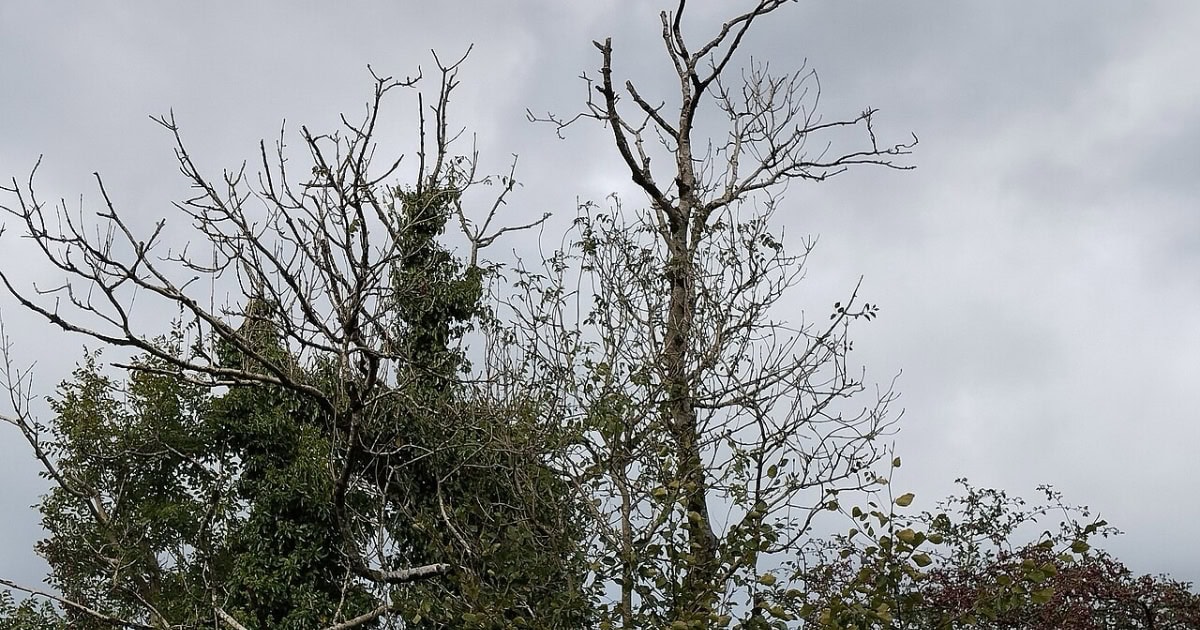
- Crown: thinning in the upper canopy, with tufted inner growth as the tree tries to recover.
- Lesions: diamond-shaped lesions where last year’s leaves were attached or on small side shoots.
Two checks you can try today:
- Photo comparison: stand in exactly the same place and compare photos from the last two summers. If the outer crown looks sparser and the inner crown looks tufted, that pattern supports ash dieback.
- Node inspection: on small branches, look closely at last year’s bud positions for those diamond lesions. Photograph with light across the bark so the shape and edges are clear.
Use symptom guides with photographs from the Tree Council and Forest Research to avoid false positives. (Tree Council owner guide, PDF; Forest Research symptoms). The Tree Council+1
Now for ash dieback lookalike pitfalls. Drought scorch in exposed roadside belts can mimic summer wilt. Ash sawfly can strip leaves in June and leave crowns thin for weeks. Honey fungus at the base can also cause dieback, especially in wet clay basins. If in doubt, book a professional inspection so you are not making decisions on a lookalike rather than ash dieback itself. (Tree Council owner guide). The Tree Council
If you see these signs above a play area, pavement or path, book a survey.
Timber markets in the North West — where ash goes when removal stacks up
Firewood and biomass. This is the most reliable outlet for diseased ash in the region. Stacked and seasoned ash sells through autumn and winter. Movement of ash timber and wood within Great Britain is permitted because the fungus does not readily spread in processed wood. (Forest Research “Chalara manual” – logs and firewood). Forest Research
Sawlog and furniture. Straight stems taken in early stages can still saw well. Leave it too long and the risk of shake and brittle fractures rises, which down-grades the log to firewood value. Forest Research price-size curves for hardwoods give a sensible benchmark for bids across diameter classes. (Forest Research price-size curves, PDF). cdn.forestresearch.gov.uk
Chip and low-grade outlets. Chipping on site can work where access is tight or where you need to clear a safety corridor at pace. Prices vary with energy and haulage costs.
Movement rules in one line. Ash timber and wood can be moved and sold within Great Britain, while plant movements remain restricted. Welsh Government and Arboricultural Association materials confirm this distinction. (Welsh Government policy; Arboricultural Association guidance, PDF). GOV.WALES+1
Line up your outlet before you cut. Logs that sit on a verge or wet ride for months lose value and generate complaints. Early buyer engagement keeps the site tidy and the numbers working.
If you plan roadside felling this winter, line up your firewood buyer now to keep stacks moving.
Ash dieback disease stages, stability and value windows
We see three practical stages on the ground:
Early stage (up to roughly one third crown loss). Hinge wood is usually reliable and the tree can be felled with normal control. This is the value window if removal is your plan: the wood is sound enough for better grades and working is more straightforward.
Middle stage (roughly one third to three fifths crown loss). More dead tops and brittle laterals. Climbing risk increases. Mechanical felling becomes the preferred method. Values drift toward firewood and biomass. The Forestry Industry Safety Accord explains why diseased ash should, where possible, be felled by machine and why exposure of ground staff should be minimised. (Forestry Industry Safety Accord guidance). ukfisa.com
Late stage (more than three fifths crown loss and basal lesions). The stem becomes brittle and prone to sudden failure. Chainsaw work near the stem should be kept to an absolute minimum. Treat this as a public safety job, not a timber job. (Forestry Industry Safety Accord guidance). ukfisa.com
Balance this with a final fact: a minority of ash trees are tolerant. Emerging research in 2025 shows young ash cohorts evolving resistance; that supports retaining some of the best individuals as seed sources where it is safe to do so. (PubMed record; Queen Mary University summary). PubMed+1
If your best stems still hold good hinge wood, act before they tip into brittle behaviour.
North West realities: wet summers, clay soils, coastal exposure and public rights of way
In our region, site conditions drive cost just as much as tree condition.
- Clay soils and wet summers. Soft ground swallows tyres. Plan for tracked harvesters and lay brash mats on rides to protect the surface. Choose a season that will actually carry the machines.
- Coastal exposure. On the Wirral, the Fylde and the Furness peninsula, repeated wind exposure creates asymmetric crowns. Expect bias when you fell edge trees.
- Roadside belts and public rights of way. Footpaths and cycle routes often run within a few metres of the tree line. Temporary closures and traffic management need early coordination with the local authority so crews are not standing idle while permissions catch up. The Tree Council has collated lessons on managing ash dieback along public rights of way, and several councils publish clear owner responsibilities. (Tree Council PROW workshop summary, PDF; West Sussex example). The Tree Council+1
If a public right of way crosses your site, plan closures and neighbour notices before the machines arrive.
Licences, Tree Preservation Orders and the “dangerous tree” exemption
- Felling licence. Most removal of living diseased ash requires a licence. There is an exemption for trees that are dead or pose a real and immediate danger. If you use that exemption, create an evidence trail: a dated survey, wide and close photographs, and notes on targets beneath the crown. (GOV.UK guidance; Operations Note 46a). GOV.UK+1
- Tree Preservation Orders and Conservation Areas. Protected trees still need consent, and emergency works must be evidenced and notified. Check with your local planning authority. (GOV.UK guidance). GOV.UK
- Restocking. Restocking is often a condition where a licence is granted. Plan a resilient, mixed palette that suits your soil and aspect. (GOV.UK guidance). GOV.UK
If you believe the dangerous tree exemption applies, document the risk before work and keep those records.
A grounded vignette from a Manchester driveway
A mature ash over a short drive and pavement in south Manchester prompted a call. We stood in the same spot and compared a July photo with one from the previous July. The outer crown had thinned and inner shoots had tufted. On a low branch we found two diamond-shaped lesions at last year’s nodes. The base was sound, and there were no lesions on the stem. We recommended a precise reduction away from the highway and quarterly monitoring rather than full removal. The owner kept access open and avoided a large bill, and we kept a potentially tolerant tree in place. (Use the Tree Council guide to structure photographs and notes.) (Tree Council owner guide, PDF). The Tree Council
If cars or pedestrians pass beneath your ash, reduce risk first and decide on removal after a fresh inspection.
A recent mini-case from the A6 corridor in Stockport
A roadside belt on clay held a mix of ash and sycamore beside a busy footway and a culvert. Crowns showed around one half loss; two stems had basal lesions. We secured weekend footway closure and traffic management, then removed five high-risk stems by machine and retained three better-performing ash that stood clear of targets. Firewood buyers took the timber, and chip stayed local. The corridor is now safe, income offset haulage, and we kept seed sources for the future. The approach aligns with national guidance to retain healthier ash where it is safe to do so. (GOV.UK guidance). GOV.UK
If some ash outperform neighbours and stand clear of targets, mark and retain them on purpose.
Pros and cons: remove now or retain and phase-fell
Remove now:
- Reduces immediate risk near paths and roads
- Captures higher timber value before brittleness sets in
- Clears ground for restocking and resilience planting
What you give up:
- Access and traffic management costs can rise in wet seasons
- You may remove potentially tolerant individuals
- Restocking and aftercare will be needed
Retain and phase-fell:
- Keeps seed sources and supports long-term resilience
- Spreads cost and disruption over time
- Maintains habitat continuity
What you accept:
- Ongoing inspections and record-keeping
- Sudden changes in stability as disease advances
- Market value drops as wood downgrades
For price awareness and timing, sense-check offers against the current hardwood price-size curves. (Forest Research price-size curves, PDF). cdn.forestresearch.gov.uk
If targets are low and crowns are holding, retention with monitoring can be the better bet.
Your next steps
- Survey and record. Photograph crowns from the same point each summer and take clear close-ups of suspected diamond lesions. (Tree Council owner guide, PDF). The Tree Council
- Rate risk and choose methods. Where trees overlook roads or public rights of way, plan mechanical methods and traffic or path management. (Forestry Industry Safety Accord guidance). ukfisa.com
- Plan access. Map wet spots and clay rides, choose a workable season, and order brash mats where needed.
- Line up buyers. Speak to firewood buyers first and sawmills if you have straight stems in the early stage. Use current price-size curves for context. (Forest Research price-size curves, PDF). cdn.forestresearch.gov.uk
- Check consents. Confirm whether a licence is required and whether a Tree Preservation Order or Conservation Area consent applies. (GOV.UK guidance). GOV.UK
- Mark the keepers. Tag the best performers that are safe to retain to support future resilience. (PubMed record). PubMed
If any step is unclear, ask us to manage the whole process end to end.
A note from a national firm: Bartlett Tree Experts
Independent industry material also advises against removing mature ash solely because of infection if the tree remains structurally sound and risk can be managed through monitoring. That stance, set out by Bartlett Tree Research Laboratories, aligns with the selective approach above. (Bartlett technical report, PDF). bartlett.com
Call to action for North West owners
If you own ash in Greater Manchester, Lancashire, Merseyside, Cheshire or Cumbria, we can help. We will survey, plan access, manage consents, and oversee removal where it truly stacks up, while retaining the right stems for the future.
Book an ash dieback survey with Tree Surveys North West and get a practical plan you can act on.
Sources and further reading
- Forestry Commission: Managing ash dieback in England. GOV.UK
- Forest Research: Ash dieback (Hymenoscyphus fraxineus). Forest Research
- Forestry Industry Safety Accord: Essential information on the felling of diseased ash. ukfisa.com
- Forest Research: Hardwood price-size curves 2024. cdn.forestresearch.gov.uk
- Tree Council: Ash dieback: a guide for tree owners (PDF). The Tree Council
- Welsh Government: Ash dieback policy approach 2024 to 2029. GOV.WALES
- PubMed: Rapid polygenic adaptation in a wild population of ash trees under a novel fungal epidemic (Science, 2025). PubMed
- Bartlett Tree Research Laboratories: Chalara ash dieback technical report (PDF). bartlett.com
Short disclaimer (England)
This article is general guidance for tree owners in England. Protected trees, including those covered by a Tree Preservation Order or within a Conservation Area, need consent. Most felling requires a licence. Emergency works must be evidenced. Always use competent, insured professionals and follow current safety guidance from the Forestry Industry Safety Accord and the Health and Safety Executive. (GOV.UK; Forestry Industry Safety Accord). GOV.UK+1
Book in your tree survey today
Get clear, professional advice from qualified tree surveyors you can trust. Whether you need a report for planning, insurance, mortgages or safety, we’ll deliver accurate results fast.